![[eMagazine] FTA Index Leader: Success Through Coordinated Investment](https://imgcdn.tapchicongthuong.vn/tcct-media/25/11/24/avata_6923b8adc9af8.png)
When the Ministry of Industry and Trade published the Free Trade Agreement Implementation Index (FTA Index) for the first time in 2024, Ca Mau made a surprising impression by taking the top position. This result, however, reflects the province’s coordinated and sustained investment.
When the Ministry of Industry and Trade published the Free Trade Agreement Implementation Index (FTA Index) for the first time in 2024, Ca Mau made a surprising impression by taking the top position. This result, however, reflects the province’s coordinated and sustained investment.

The 2024 FTA Index was conducted nationwide to assess the implementation and utilisation of free trade agreements in force in Viet Nam across four areas corresponding to its four component indicators: (1) businesses’ access to FTA information; (2) compliance with domestic legislation adopted to implement FTA commitments; (3) the effectiveness of programmes and policies supporting businesses in using FTAs; and (4) implementation of sustainable development commitments at the local level. The survey also recorded the difficulties and obstacles encountered by businesses.
The survey provides a comprehensive picture of FTA Index rankings across provinces and cities. The composite score is calculated from four component indicators, each measured on a 10-point scale, giving a total of 40 points. Ca Mau recorded the highest composite score, at 34.90, while Quang Tri had the lowest, at 14.49. The national mean was 26.20 and the median was 20.40.
Ca Mau ranked first nationwide in the composite FTA Index with 34.90 points, followed by Thanh Hoa (34.13), Binh Duong (34.02), Khanh Hoa (32.92), Tra Vinh (32.74), Long An (32.50), Ha Giang (32.46), Bac Lieu (32.43), Ninh Binh (31.74) and Dien Bien (31.72).
Ca Mau also ranked among the 10 leading provinces in every component indicator. It placed fourth for access to FTA information, fourth for implementation of FTA-related legal provisions, second for programmes supporting FTA implementation, and ninth for implementation of sustainable development programmes under FTA commitments.
2024 composite FTA Index ranking (Source: Ministry of Industry and Trade)
Ca Mau’s top ranking in the inaugural FTA Index may surprise many observers, given the province’s remote location and continuing infrastructure constraints.
Nevertheless, the province has favourable conditions for international economic exchange and development. It is the only province in Viet Nam bordered by the sea on three sides, with more than 254 kilometres of coastline and fishing grounds covering approximately 80,000 square kilometres. Ca Mau has abundant aquatic resources and diverse saltwater, freshwater and brackish-water ecosystems. Its aquaculture area exceeds 300,000 hectares, and the province leads the country in farmed shrimp output while also producing a range of other agricultural products.
In recent years, greater economic openness and the implementation of FTAs have helped many of the province’s key products reach major global markets. In 2024, Ca Mau’s exports exceeded USD 1.2 billion, up 5.31% from 2023 and above the annual target. Key products, particularly seafood such as shrimp and crab, accounted for 88.4% of total export value and were sold in more than 60 countries and territories, including the United States, the European Union, Japan, the Republic of Korea, China, Australia and Canada.
In the same year, Ca Mau’s imports reached USD 227.31 million, nearly 82% higher than in the previous year. Imports consisted mainly of wind-power equipment and fertilisers, reflecting the modernisation of production and the strengthening of local value chains.
In 2024, Ca Mau attracted eight foreign direct investment projects with total registered capital of USD 78.08 million from Australia, Japan, the Republic of Korea and Taiwan (China), among others. The province also signed 17 international cooperation agreements with partners and localities in Cambodia, Laos, Thailand, the Republic of Korea and Japan, focusing on agriculture, fisheries, tourism, labour and services. These agreements provide a strong foundation for broader cooperation, resource mobilisation and technology transfer from advanced partners.
Speaking at the ceremony announcing the 2024 FTA Index, Pham Thanh Ngai, Deputy Secretary of the Provincial Party Committee and Chairperson of the Ca Mau People’s Committee, said that the province recognises new-generation FTAs as a prerequisite for seizing development opportunities while mitigating risks in exports and investment attraction. In recent years, Ca Mau has actively introduced measures to make effective use of these agreements. It established a Steering Committee for International Integration and promptly issued specific action plans assigning responsibilities to individual agencies and local authorities. Each year, the province holds thematic conferences on integration and FTAs to provide updated information and help businesses develop production and business strategies aligned with global market trends.
The province has also implemented business support programmes ranging from advice on machinery and equipment, applications of science and technology, and production innovation to assistance in resolving difficulties, particularly access to capital and other resources. Trade promotion has been renewed, especially support for market access and proactive connections between local businesses and importers. Activities such as the Ca Mau Shrimp Festival, the Crab Festival, meetings between provincial businesses and buyers, and international trade promotion conferences for agricultural and seafood products have helped promote products and attract trade and investment.
The 2024 FTA Index survey recorded positive changes within the local business community and provided further impetus for Ca Mau to improve its mechanisms, strengthen integration and make more effective use of FTAs.
However, Ca Mau faces significant challenges as the United States - its principal market for seafood exports - applies reciprocal tariffs and other markets introduce increasingly stringent trade policies, standards and regulations. In response, the provincial People’s Committee has worked with businesses, associations and export-processing establishments to diversify export markets and develop appropriate response measures.
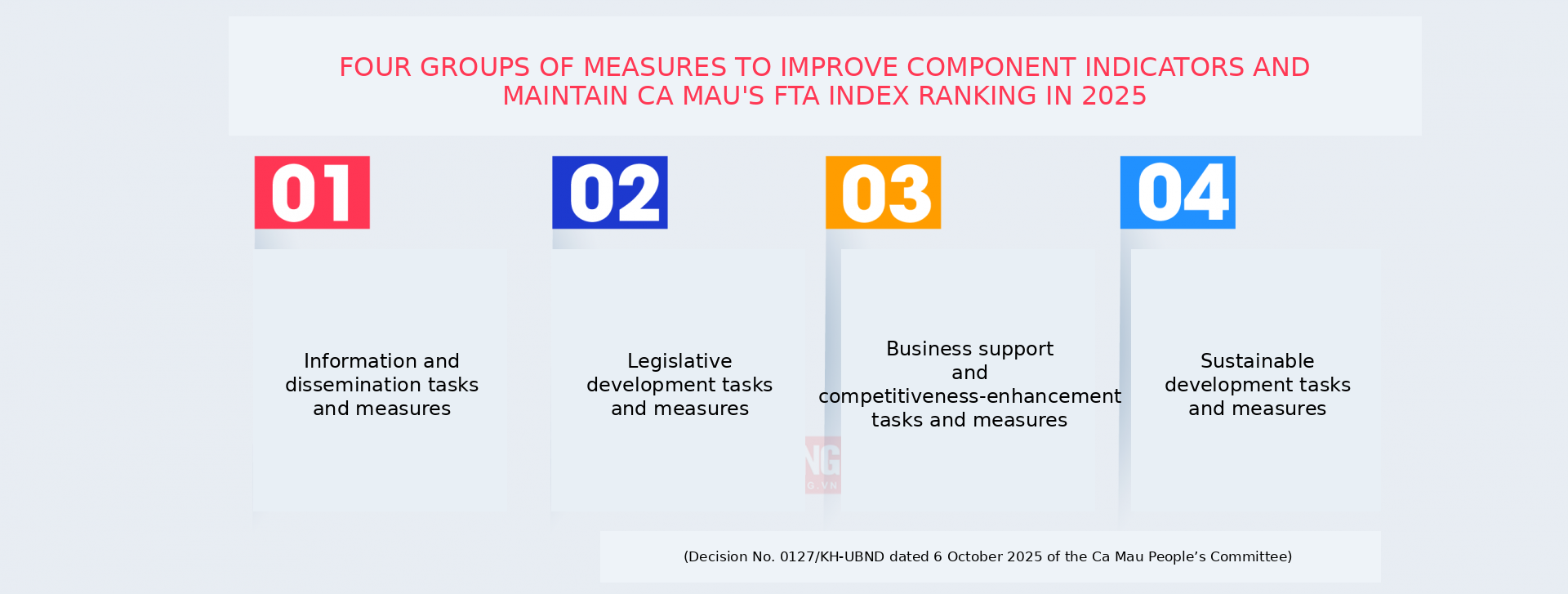
Most recently, following the publication of the 2024 FTA Index results, the provincial People’s Committee issued a plan for 2025 to improve the component indicators and maintain Ca Mau’s FTA Index ranking.
The plan seeks to maintain Ca Mau’s overall FTA Index ranking while improving the scores and rankings of its four component indicators: (1) communication and dissemination of FTA information; (2) development and implementation of legislation by local government agencies; (3) policies supporting stronger competitiveness; and (4) implementation of sustainable development commitments. The provincial People’s Committee has assigned departments, agencies and local authorities to implement four corresponding groups of priority measures and tasks.
Implementation of the plan is intended to strengthen responsibility, dynamism and initiative among departments, agencies and commune- and ward-level People’s Committees in improving Ca Mau’s FTA Index performance. Particular attention will be given to practical business support measures, effective communication formats and content, and detailed programmes and policies that reflect businesses’ needs and operations.
Source: Ministry of Industry and Trade Magazine